Kitchen, Cabinet and Joinery Respraying
Cabinets, wardrobes and fitted joinery taken back, prepared and sprayed to an even, smooth finish.
About Cabinet & Joinery Respraying
The short answer
RS Spray Decor resprays kitchen cabinets, drawer fronts, fitted wardrobes and joinery across Surrey and south-west London. Doors are taken off and sprayed, frames and fixed sections are masked and sprayed in place, and the finish is a smooth, even coat that a brush or roller cannot match. It is an alternative to replacing cabinetry that is still structurally sound. Free, no-obligation quotes.
Respraying is the specialist end of what RS Spray Decor does, and it is a different job from painting a kitchen with a brush. Doors and drawer fronts come off and are sprayed properly; frames, end panels and fixed joinery are masked and sprayed in place. The result is an even film with no brush marks and no roller texture.
The finish is only ever as good as what happens before it. Degreasing, abrading and choosing a primer that actually bonds to the surface in front of us is where the durability comes from, and it is why a proper look at the doors comes before any quote. Respraying can transform an existing kitchen at a fraction of the cost of replacing it outright.
Spray work is contained. Work areas are masked and sheeted, adjoining rooms are shut off, and the space is cleaned down at the end rather than left for someone else to deal with.
Spraying runs through a state-of-the-art spray booth setup, with dust extraction, air scrubbers and the latest sprayers and dustless sanders keeping the job clean and the finish free of grit.
Restoring and respraying a kitchen that still works also means less unnecessary waste - fewer old units to landfill, and less scope for microplastics and other material waste to end up in water systems and the wider environment.
What it covers
- Kitchen doors and drawer fronts
- Cabinet frames, end panels and plinths
- Fitted wardrobes and built-in furniture
- Internal doors, frames and architrave
- Panelling, shelving and bespoke joinery
- Painted island and utility units
What it suits
- Solid timber, MDF and primed factory-finished doors in sound condition
- Melamine, laminate and foil-wrapped fronts where the surface is intact and not lifting
- Fitted joinery that is well fixed and square, whether recently built or long-installed
- Kitchens where the carcasses, hinges and runners still work and only the finish is tired
The specialist service: spraying existing cabinetry and joinery so it looks renewed without being replaced.
Before any finish goes on
This is the part that decides whether a sprayed finish still looks right years later. It is also the part that is invisible once the job is done, which is exactly why it is worth setting out.
- 01
Every surface is assessed first. Lifting foil, blown edges, water damage or a soft, flaking existing coating all change what is possible, and it is better to say so before quoting than after starting.
- 02
Doors and drawer fronts are unscrewed, labelled and their hardware bagged so everything returns to the opening it came from.
- 03
Surfaces are degreased. Kitchens in particular carry cooking residue that no primer will bond through, so this stage is not optional.
- 04
Faces and edges are abraded to give the primer a key, then dust is removed rather than wiped around.
- 05
A primer is chosen for the substrate in front of us, not applied as a single default across every job.
- 06
Worktops, floors, appliances, sockets and any adjoining room are masked and sheeted, and the work area is separated off before a gun is picked up.
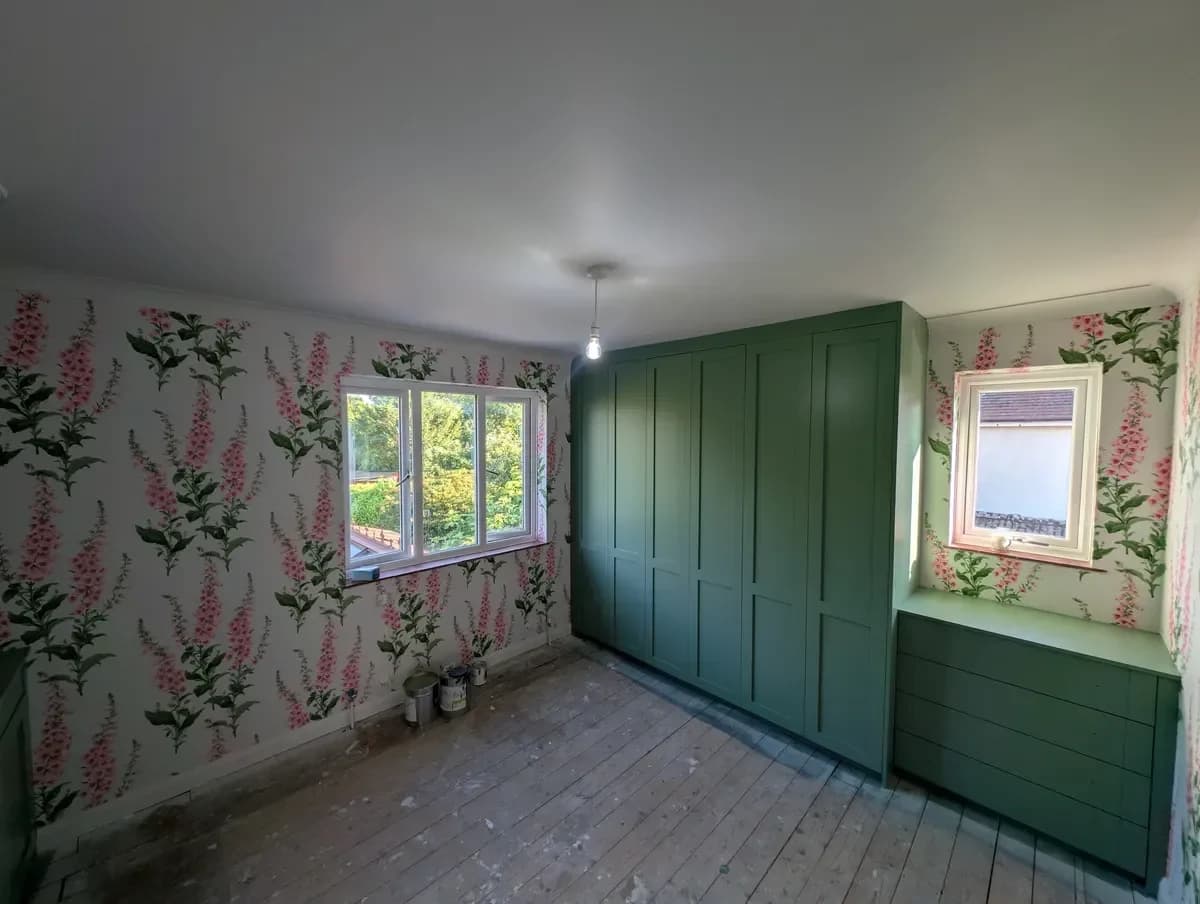
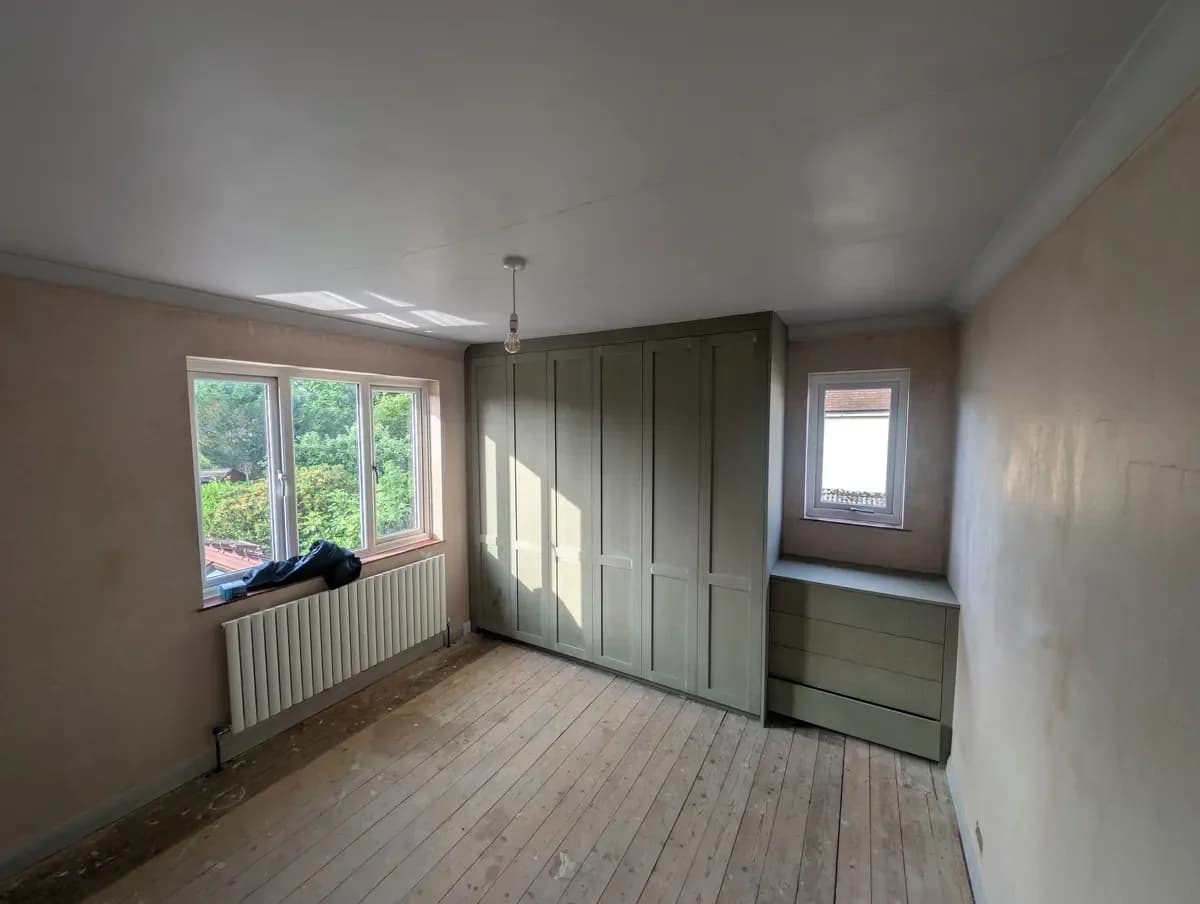
The same room, before and after
How a cabinet & joinery respraying job runs
- 01
Look at the job
In person, or from photos over WhatsApp if that is quicker. The important part is establishing what the doors are actually made of and what condition they are in.
- 02
Quote and finish choice
A written quote, with colour and sheen agreed before anything is ordered, plus a realistic answer on how long the kitchen will be out of normal use.
- 03
Strip out and protect
Doors and drawer fronts removed and labelled, hardware bagged, and the room masked, sheeted and separated from the rest of the house.
- 04
Degrease, abrade, prime
The stage that decides whether the finish lasts. Cleaned, keyed, dust removed, then primed with something suited to that specific surface.
- 05
Spray
Doors sprayed off the frames, fixed sections sprayed in place behind masking, built up in even coats rather than one heavy one.
- 06
Cure, refit, check
Coatings left to harden, doors refitted to the openings they came from, alignment checked, and the whole room cleaned down before we leave.
What you get to choose
- Sheen from flat matt through to full gloss, chosen for the room and how hard the surface gets used
- Colour matched to a sample, an existing scheme or a manufacturer's reference you supply
- Different specifications for kitchen doors, wardrobe fronts and internal joinery, because they take different wear
- Premium German paints, A+ rated and virtually free from plastics and resins
Where this is not the right job
- Lifting or bubbling foil wrap and swollen MDF edges do not automatically mean a kitchen needs replacing. In many cases these can be repaired and properly prepared before spraying, so damaged surfaces are assessed first rather than ruled out on sight.
- Kitchen respraying can transform an existing kitchen at a fraction of the cost of replacing it completely, provided the carcasses are structurally sound.
- Sprayed coatings need time to cure and reach full hardness. Doors can be refitted before that, but they want handling with care for a while afterwards.
- Very heavily textured or previously badly finished surfaces can often be restored and transformed with the right preparation, though the result depends on their starting condition.
- Professional DecoratingRoom-by-room interior work, where the preparation and the woodwork matter as much as the wall colour.
- Interior and Exterior PaintingProperty-scale painting, and the outside of the building - where the substrate and the weather set the rules.
- uPVC SprayingThe uPVC-specific service: colour and finish rather than replacement, on a substrate that needs its own preparation and coatings.
- Commercial DecoratingWork in premises that have to keep functioning, where sequencing matters as much as the finish.
- WallpaperingPaper rather than paint - where the wall underneath and the pattern repeat decide the result.
Cabinet & Joinery Respraying across Surrey and south-west London
Every town below has its own cabinet & joinery respraying page with local detail.
- Guildford
- Weybridge
- Kingston upon Thames
- Staines-upon-Thames
- Twickenham
- Cobham
- Windsor
- Ashford
- Esher
- Walton-on-Thames
- Woking
- Leatherhead
- Epsom
- Sunbury-on-Thames
- Feltham
- Chertsey
- Virginia Water
- East Molesey
- Hersham
- Byfleet
Cabinet & Joinery Respraying questions
Can you respray kitchen cabinets instead of replacing them?
Usually, yes, where the carcasses are sound and the hinges and runners still work. Doors and drawer fronts come off and are sprayed, frames, end panels and plinths are masked and sprayed in place. It is an option worth considering when the cabinetry still does its job and only the finish is tired.
Why does degreasing matter so much on kitchen doors?
Cooking leaves a fine film of grease on every surface in a kitchen, and it is heaviest on the doors nearest the hob. No primer bonds through that film, so a door that has only been sanded and sprayed can look perfect for a few months and then start peeling around the handles. Degreasing first is the step that decides whether the finish stays on.
How do you decide which primer to use?
By what the door is actually made of. Bare or previously painted timber, MDF, melamine, laminate and foil-wrapped fronts all take different primers, and a factory-finished door already carries a coating that the new primer has to grip. Using one default primer on every job is the usual reason a sprayed kitchen chips early.
Can melamine, laminate or foil-wrapped doors be sprayed?
Usually, yes, with the right primer for that surface. Lifting or bubbling foil at an edge does not automatically rule a door out either - it can often be repaired and properly prepared first. Every surface is assessed before quoting so you know what is realistic before any work starts.
How do you stop overspray reaching the rest of the house?
Containment is most of the work. Doors and drawer fronts come off so they can be sprayed away from the room, worktops, floors, appliances, sockets and light fittings are masked and sheeted, and the work area is closed off from the rest of the property before a gun is picked up.
Do you spray on site or off site?
Both, on the same job. Doors and drawer fronts are removed, labelled and sprayed away from the room where the air is controlled. Frames, end panels, plinths and anything fixed in place are masked and sprayed where they stand.
How long will my kitchen be out of normal use?
It depends on the number of doors, the finish chosen and how long the coatings need to harden. Richie will give you a realistic answer at the quote stage rather than an optimistic one, because if the timing is going to be inconvenient it is better to know that before the work starts.
How durable is a sprayed finish in a working kitchen?
A sprayed coating that has been properly degreased, keyed and primed stands up extremely well to everyday kitchen use. Durability comes from thorough preparation, professional application and allowing the coating to cure correctly. RS Spray Decor uses professional furniture-grade paints and coatings specifically suited to this type of work, rather than standard paints typically available from local decorators' merchants. Doors can be refitted before the coating reaches its full hardness, although they should be handled with a little extra care while the finish completes its curing process.
What sheen should I choose for cabinet doors?
Satin and eggshell are the usual choice in a kitchen. They wipe clean, they hide small imperfections better than gloss, and they do not throw reflections across a run of doors. Flat matt looks superb but marks more easily on surfaces that get handled constantly. Full gloss provides a sharper, highly reflective finish.
Will the texture of the existing doors still show through?
Preparation is a major part of the respraying process. Existing surfaces are thoroughly cleaned, prepared, sanded and repaired where necessary before spraying to achieve the smoothest and most consistent finish possible. The exact result will depend on the original condition of the doors, but most surfaces can be significantly improved before the final coating is applied.
Can you spray joinery other than kitchen cabinets?
Yes. Fitted wardrobes, built-in furniture, internal doors, frames and architrave, panelling, shelving and bespoke joinery are all sprayed the same way. Wardrobe fronts and internal joinery take different wear from kitchen doors, so the specification is not identical.
Can you match an existing colour?
Yes. Colour can be matched to a sample you have, to an existing scheme in the room, or to a manufacturer's reference you supply. Colour and sheen are both agreed in writing before anything is ordered.
What condition do the doors need to be in?
Most conditions are workable. Water-damaged or swollen MDF edges can usually be repaired and properly prepared before spraying, and a soft or flaking existing coating is removed rather than sprayed over. Everything gets looked at before quoting, which is why a proper look at the doors comes first.
How do I get a quote for cabinet or joinery work?
Photos are often enough to get you a sensible number quickly. Send a few of the doors and the room to 07990 035522 on WhatsApp, or call and arrange a look in person. Quotes are free and carry no obligation.
What paint products do you spray?
Premium German paints, A+ rated and virtually free from plastics and resins. The exact specification is confirmed with you before anything is ordered, including the product used for both primer and topcoat.
Does everything have to be sprayed in my house?
No. There is access to a state-of-the-art spray booth, so doors, drawer fronts and loose joinery can be finished off site in controlled conditions and brought back to be refitted. Fixed sections such as frames, end panels and plinths are masked and sprayed in place.
How much dust does the preparation make?
Far less than a sanding job normally does. Dustless sanders take the dust off at the tool rather than into the room, and air scrubbers pull the fine airborne particles out of the air so they are not still floating around to settle on a wet coat.
What happens to spray equipment washout on site?
Washout is captured and dealt with as part of the job rather than put down a drain.
Get a free cabinet & joinery respraying quote
Tell us what the job is. If photos are easier than words, WhatsApp them over - for kitchens and cabinet work that is usually the fastest route to a sensible number.
What happens next
- 01Richie reads it himself - there is no call centre in between.
- 02You get a reply the same or next working day, by whichever method you asked for.
- 03If photos or a look in person are needed to quote properly, we will say so rather than guess.
Covering Surrey and south-west London, from Ashford, Surrey.